Parcel Uncle Rider
A live rider delivery app with real road routing, multi-stop optimization and live tracking, built entirely on open source maps with no paid map SDK.
The problem
Every logistics app needs maps and routing, and the default answer is Google Maps. That holds until a rider app is making thousands of calls a day — geocoding addresses, drawing a route for every trip, refreshing a live location every few seconds. At that volume the map SDK stops being a library and becomes one of the largest line items in the product, and it grows with usage rather than with revenue. This app needed real road routing, live rider tracking and multi-stop delivery ordering on a budget where a paid map SDK was never an option.
The approach
- 01
flutter_map with OpenStreetMap tiles instead of a paid SDK. The honest trade is that Google sells tiles, routing and geocoding as one package, and doing without it means assembling those pieces yourself and owning the performance work the SDK would otherwise have hidden.
- 02
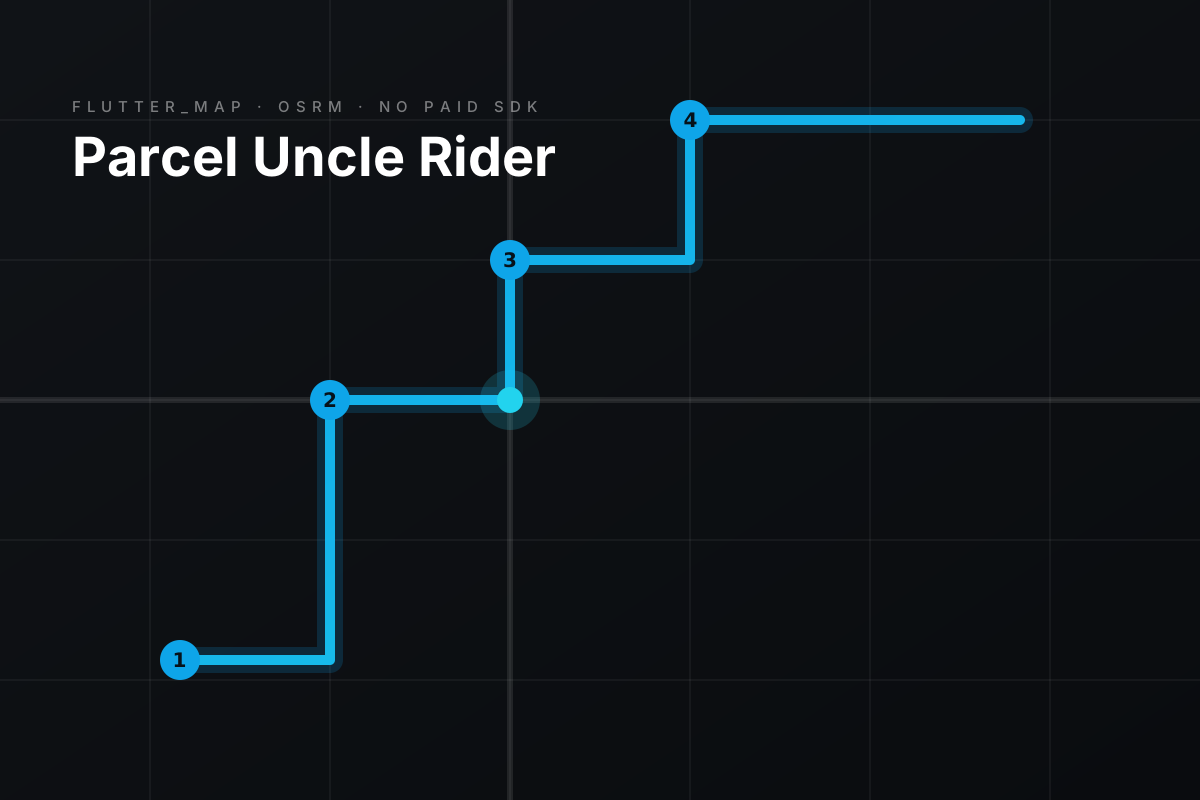
OSRM for routing, so the app draws the road a rider will actually ride rather than a straight line between two pins. Routes come back as real road geometry and are rendered as polylines over the map.
- 03
Stop-order optimization lives on the backend, not in the app. Flutter asks a REST endpoint for the best order of delivery stops and renders the answer. Keeping it server-side means the routing logic can be changed without shipping a new build, and the phone is never doing the expensive part.
- 04
Live rider location and online or offline status on the map, tuned so that continuous tracking does not drain the battery. This took more iterations than anything else in the build, because the naive version works perfectly in testing and ruins a rider’s day.
- 05
Tile caching, and keeping the map smooth on low-end Android phones — which is what riders actually carry, not the device the app was developed on.
The result
Live in production and in daily use by riders. The architecture became a 20-minute talk accepted at flutterCon India 2026 in Bengaluru on 21 November, alongside Google Developer Experts. The part worth repeating is not that open source maps are free — it is that once routing moves to your own backend, the map in the app becomes a rendering problem rather than a billing one.
Built by
Zaid Sayyed
Software Engineer · AI & Cross-Platform Apps. Open to roles and freelance work.